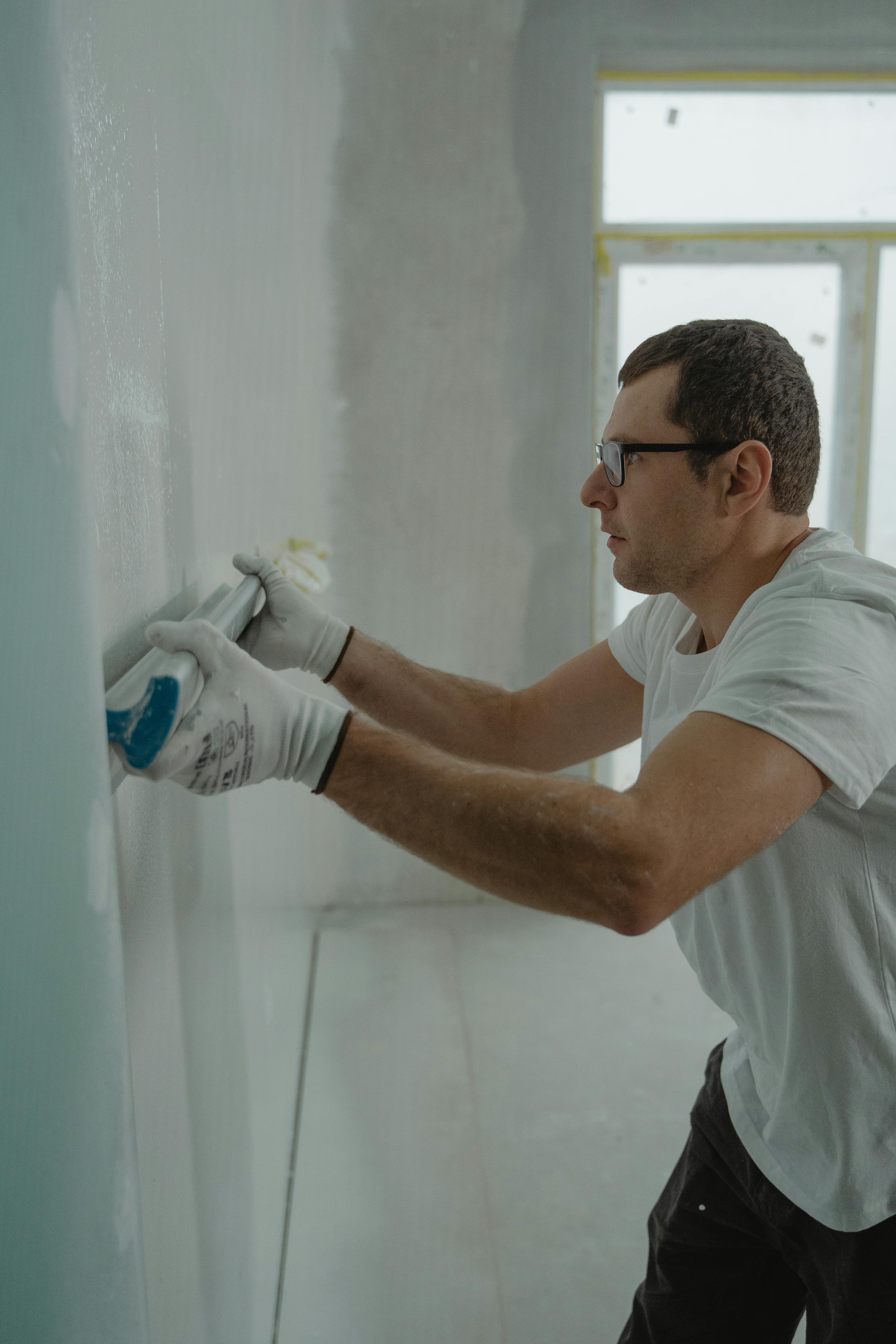
Matching drywall texture requires identifying your existing pattern (orange peel, knockdown, popcorn), selecting the right tools (spray cans for small patches, hopper gun for larger areas), and practicing on cardboard first. For knockdown texture, timing is critical—wait 10-15 minutes until the wet shine disappears before flattening. Always prime repairs before texturing.
Texture matching is often the hardest part of drywall repair. A perfect patch with mismatched texture still looks like a repair. The good news: spray products make small-area matching achievable for DIYers.
What You’ll Need
Tools:
- Knockdown knife (18”) — rubber preferred over metal
- Extension pole
- Drop cloths
- Safety goggles
- Charcoal respirator
Materials:
- Texture spray (Homax or similar): $15-20/can
- PVA primer: $10-15
- Cardboard for practice
Identify Your Texture Type
| Texture | Description | Identification |
|---|---|---|
| Orange Peel | Small, uniform bumps like citrus skin | No flat spots; subtle, dimpled surface |
| Knockdown | Mottled, stucco-like with flattened peaks | Mix of flat AND raised areas; ~60% open space |
| Popcorn | Bumpy, cottage cheese appearance | Raised rounded bumps; usually white |
| Skip Trowel | Sparse globules, hand-applied | ~50% coverage; quarter-sized spots |
| Smooth | Completely flat, no texture | Shows every imperfection |
Take photos of your existing texture in angled light before starting. Use these as reference when practicing on cardboard—matching the density and pattern is more important than the exact technique.
Spray Texture Products
Homax Product Line (Market Leader)
| Product | Type | Coverage | Price |
|---|---|---|---|
| Pro Grade Dual Control (25 oz) | Orange Peel/Knockdown | 75-125 sq ft | ~$16-20 |
| Orange Peel Water-Based (20 oz) | Orange Peel | 70-125 sq ft | ~$15-20 |
| Knockdown Ceiling (20 oz) | Knockdown | 30-60 sq ft | ~$15-20 |
How to Use Spray Texture
- Warm the can — If cold, place in warm water bath for 15-20 minutes
- Shake vigorously — Shake upside-down until ball rattles, then continue 1 full minute
- Adjust nozzle — Clockwise for finer texture, counterclockwise for heavier
- Spray distance — Hold 18-24 inches from surface
- Motion — Use circular motion (not sweeping)
- Coverage — Aim for 80% coverage in random pattern
Spray Can Limitations
- Best for patches under 4 square feet
- Difficult to match aged/painted textures
- Can clog on ceilings (many user complaints)
- Cannot replicate hand-applied textures
- May need 4+ cans for larger areas ($80+)
Orange Peel Texture
Orange peel is the easiest texture to match with spray cans.
Application:
- Prime repair area; let dry
- Practice on cardboard to match density
- Hold can 18-24” from wall
- Spray in circular motion
- Build up gradually—lighter coats are easier to match
- Let dry 30-60 minutes before painting
Matching tips:
- Finer texture = farther distance, higher pressure
- Heavier texture = closer distance, lower pressure
- Match the “density” of bumps, not just size
Knockdown Texture
Knockdown requires an additional step—flattening the peaks with a knockdown knife.
Critical Timing
Wait 10-15 minutes after spraying until the wet shine disappears but before texture sets. This window is crucial:
- Too early: Texture smears and creates mess
- Too late: Texture won’t flatten, leaves rough edges
- Just right: Peaks flatten smoothly, valleys remain
Step-by-Step Knockdown
- Spray texture — Aim for 40% coverage (60% open space for knockdown effect)
- Wait for timing — Watch for wet shine to disappear (10-15 min)
- Attach knockdown knife to extension pole
- Drag in straight passes — Overlap each pass by 3”
- Wipe knife with damp rag after EVERY pass
- Work inward from edges
- Don’t veer around obstacles—go straight through
The biggest knockdown mistake is not wiping the knife. Compound builds up quickly and creates drag marks. Keep a damp rag in your other hand and wipe after every single pass.
Why Priming Matters
Always prime before texturing:
- Unprimed patches absorb texture unevenly
- Creates visible “picture frame” effect around repairs
- Primer creates uniform surface for consistent adhesion
Recommended primers:
- KILZ PVA Drywall Primer
- Sherwin-Williams PVA
- Benjamin Moore Fresh Start
Practice on Cardboard
Never spray directly on your wall first. Always practice:
- Get large cardboard pieces (at least 2x2 ft)
- Test at various distances (12”, 18”, 24”)
- Adjust nozzle settings between tests
- For knockdown, practice timing on separate pieces
- Compare results to existing wall in similar lighting
- Match density and randomness of original
When Texture Matching is Impossible
Some situations require retexturing the entire wall or ceiling:
Can’t Match With DIY Methods
- Hand-applied textures — Skip trowel, hawk and trowel patterns are unique to each applicator
- Heavily painted surfaces — Multiple paint layers create depth impossible to replicate
- Aged textures — 20+ years of paint and settling changes appearance
- Popcorn ceilings — Water-based products cause existing popcorn to fall off
Popcorn Ceiling Warning
Pre-1990 popcorn ceilings may contain asbestos. DO NOT scrape, sand, or disturb without professional testing (~$480 average for testing).
Options for popcorn:
- Professional removal: $9-20/sq ft
- Cover with new drywall
- Install ceiling tiles
When to Call a Pro
Hire a professional for:
- Large areas over 100 sq ft
- Hand-applied texture matching
- Popcorn ceiling work (especially pre-1990)
- High or vaulted ceilings
- After 2-3 failed DIY attempts
- Seamless blend critical for resale
Cost comparison:
- DIY materials: $20-80
- Professional knockdown: ~$2/sq ft
- 10x14 room ceiling: ~$280 professional vs. $50-100 DIY
Common Mistakes to Avoid
- Skipping primer — Creates visible “picture frame” around repair
- Not practicing — Always test on cardboard first
- Wrong knockdown timing — Too early smears; too late won’t flatten
- Not wiping knockdown knife — Creates drag marks
- Applying too thick — Can’t knockdown properly; harder to match
- Wrong compound consistency — Too thick won’t spray; too thin smears
- Coating surrounding texture — Spray only the repair; blending wider makes it worse
Frequently Asked Questions
How do I identify my drywall texture type?
Orange peel has small, uniform bumps like citrus skin with no flat spots. Knockdown has irregular mottled patterns with both flat and raised areas (60% open space). Popcorn has raised, rounded bumps like cottage cheese. Skip trowel has sparse, quarter-sized globules covering about 50% of the surface.
Why is knockdown texture timing so critical?
You must knock down the texture when the wet shine disappears but before it sets—typically 10-15 minutes after spraying. Too early and you’ll smear it; too late and it won’t flatten. Practice on cardboard first to learn the timing in your conditions.
Can I match any drywall texture with spray cans?
Spray cans work well for orange peel and light knockdown on small repairs under 4 square feet. They struggle with heavy textures, hand-applied patterns like skip trowel, and matching aged/painted surfaces. For large areas or exact matching, rent a hopper gun or hire a professional.
Related Guides
- Drywall Repair Guide — Complete overview of drywall repairs
- How to Patch Small Drywall Holes — Quick repairs for nail holes
- How to Tape and Mud Drywall Seams — Finish repairs before texturing